Recently, with 150mm rainfall in the Oorlogspoort area, privately run school bakkies were not all able to get through some mud roads to Umthombo Wolwazi . Oom Maeder and Oom Jasper mulled these old days over stoep koffie, after the time honoured sans-kits-koffie fashion.
The old RMS (Road Motor Service) system, as it was when the service was canned by SAR&H, did not have capacity for all the learners who make their way from Colesberg to Umthombo Wolwazi every day. I found some good pics of them. All of the RMS vehicles in the following pics were crafted by SAR&H workshops on top of imported 6 x 4 chassis, some with walk-over wheels. Nothing much stopped them, quite remarkably because many towed large trailers through mud and drifts behind them.
OPPIE STOEP
JC: What happened to the RMS between the two ‘bergs, Coles- and Steyns-?
MO: Progress! Of course! It disappeared just about when it could have been useful for learners at Umthombo Wolwazi.
JC: Those old heavy RMS trucks did not typically get bogged down, though there were exceptions, so arguably, they were a better idea for learner transport than the Umthombo Wolwazi ‘bakkie brigade’.
MO: I can’t remember what the passenger combo option could accommodate.
JC: There were a variety of cab sizes up front. The standard combo vehicle had space for only 20 passengers, the middle sized one could take 35. It had a shorter load section, but with a very stout towbar for four-wheeled trailers. It was designated 3rd class back in the day, meaning that comfort was not the top priority, At fifteen years of age. My sister and I went on one, from Piet Retief to Mahlanya Halt, near Mbabane. It rattled louder than anything I have ever been on since. Usutu valley corrugations were world class, and defeated the best coach builders. Technology has moved on: these days a 570 ton double decker Airbus A380 jetliner crashes chaotically into a slab of concrete every day of its service life, yet never develops a single rattle. Corrugations!
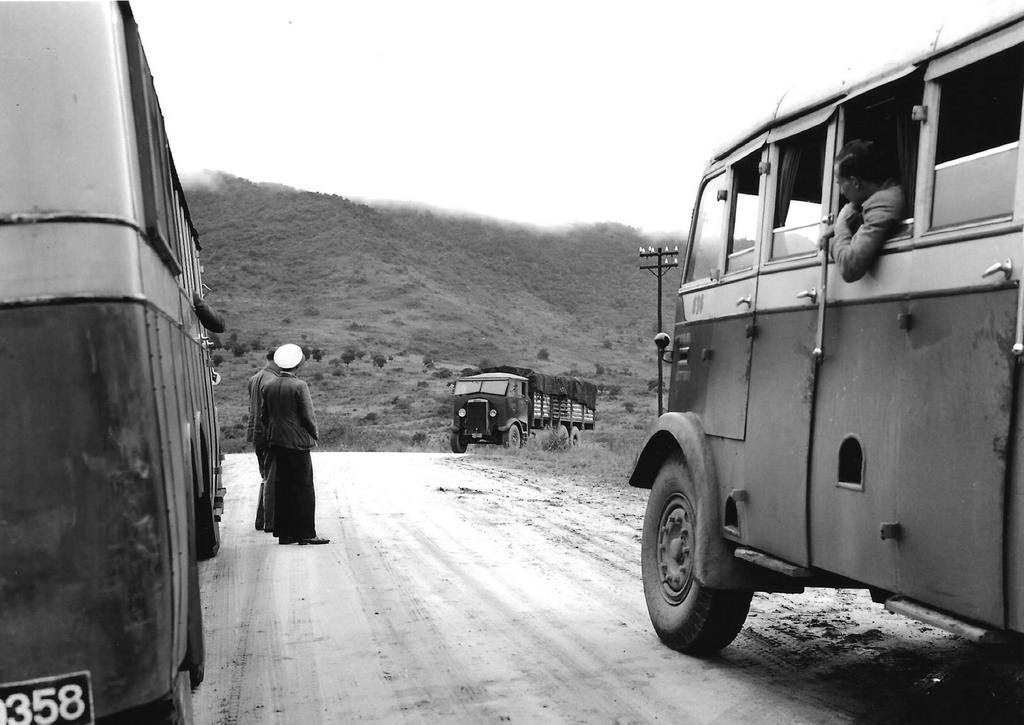
JC: See how beautiful this Transkei road was for those old RMS vehicles … and that was probably in the fifties. Progress?
MO: It is true that they did not get bogged down often, but floods did stop them here at Hanglip.
JC: Try a bakkie in a flood!
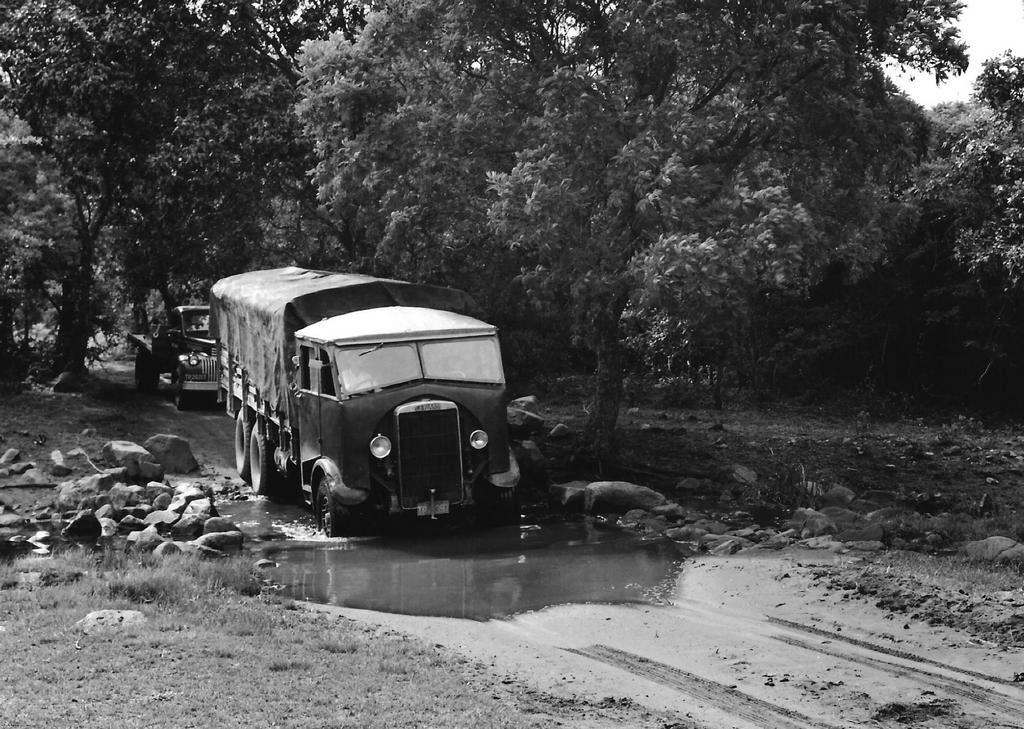
MO: The learners did once have a donated, large bus, but its back suspension was ripped out on a rough road.
JC: Wow! That must have been on that bad patch, through the koppies, near Colesberg station, right?
MO: Nooit!. It was ripped out right in Colesberg on a ‘Made In South Africa’ award-winning pothole, there near the church.
JC: Eish. Serious Greek.
MO: Greek?
JC: Well, Potholes is a Greek name, right?
[MO Casts a glance to the heavens]
MO: Maybe Russian?
JC: No, I am not in a hurry.
[MO Casts a glance to the heavens]
MO: Lord, save us 🙄.
JC: Seriously, though, an Mzansi firm that gets rural buses right would sell them continent-wide. Even Brazil and that is BRICS, with whom we are supposed to be playing nice. There are hell-roads in rain-forests all over the world. Yet, the best we can come up with is, admittedly good, military vehicles. It doesn’t say much for SA priorities: we like to make special vehicles to help kill people, but getting rural pupils to school is so dull.
MO: What could they have done differently?
JC: Plan, for a start: in the fifties, there were six million of us. Now there are sixty-two million. It didn’t happen overnight. The Nat government built thousands of kilometres or roads and rail, hundreds of tunnels bridges and dams. Try asking in parly how many kilometres of rail democratic government has added.
MO: Do you know the answer?
JC: Unsure, but I do know about 80 kms of Standard Gauge - that is Gautrain - and perhaps 4 km of Cape Gauge. Then, for real-world accounting, the Nat government has to account for what it removed, too, meaning thousands of kilometres of branch lines. RMS closures started in 1981, when SAR&H became SATS. RMS became Autonet maybe around 1988. I had never heard of Autonet until recently. It became Translux and City to City, and they became Autopax. That failed, too, absorbed by PRASA. It used to get people to all the SADC coutries. Now, City to City is said to be buying spiffy new Irizar coaches, but rural roads are left to minibuses. That is a real pity, because none are rough road capable. The last competent minibus suspension was on the old Volksiebus.
MO: RMS plying the Colesberg-Steynsberg road is unlikely to generate a profit.
JC: True. But roads don’t generate profit. There is no such thing. Why cost out rail but not roads? Passenger services are a pure social enabler. Even the early Nat government used transport as a development tool.
MO: How would you recreate RMS?
JC: Diesel hybrid trucks and railcars. For rural road trucks, that is - no gearbox or diff to strip, small constant RPM air cooled diesel. Massive torque. If a Canadian Truck business like Edison Motors can do it, we can. In fact, SAR was building single-wagon self-powered railcars more than a century ago, even building steam versions before 1900. But petrol railcars were around just after Union. To bring back all three of SAPO, branch lines and long range branch line passenger trains, a single workshop could be shared for hybrid systems on both railcars and “the Return of RMS”. Nothing I am suggesting is new.
Jasper has already written about branch line revival here. It concentrated on battery powered trainsets, but for real rural long range operation, hybrid is still the one to beat, particularly if natural gas from sewage plants can be used in place of diesel.
MO: Am I right that both these trucks and the railcars could serve as generators when parked?
JC: Yes. Triple purpose! mobile eye and dental trains and the like, can go and work anywhere, even powering rural clinics when solar is insufficient.
MO: What would be your benchmark for the “New RMS”?
JC: A bus service up Sani Pass or over Prince Alfred Pass should set the bar quite high enough!
MO: You are right - it’s raining development!
In part two, JC will sketch out his design for his new rural bus, called the “Joh-Joh”.
Comments